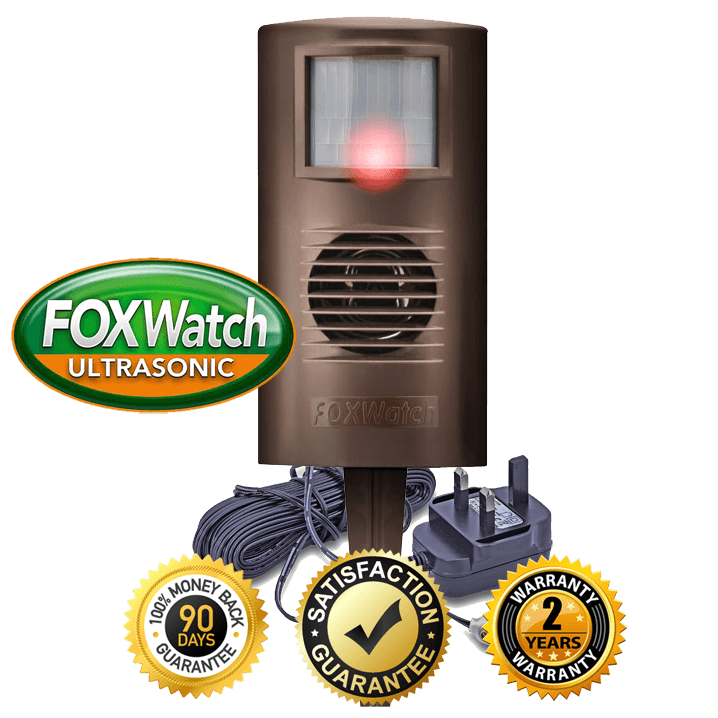
Do ultrasonic fox deterrents actually work?
If you’re reading this, it’s probably because foxes have become a recurring problem in your garden. Perhaps you’ve had yet another morning discovering dug-up lawns, rubbish strewn across the garden, or a fresh mess left on the patio.
For many people across the UK, these aren’t one-off incidents but an ongoing frustration, so you’re definitely not alone.

Like most people, you’ve probably searched for humane, practical solutions, and ultrasonic deterrents often appear near the top of the list.
The idea seems straightforward: a small device that emits a high-pitched sound, undetectable to humans but irritating to foxes, encouraging them to steer clear of your garden.
It’s an appealing promise, but if you’ve heard mixed reviews, you might be sceptical. Can a simple sound really make such a difference?
That’s a fair question, and one worth asking before investing in anything.
In this article, we’ll break down exactly how ultrasonic fox deterrents work, what the science tells us about their effectiveness, and what you can realistically expect when using one.
Most importantly, we’ll highlight a trusted, British-made device that’s been helping people reduce fox problems in their gardens for nearly two decades, and explain why patience and persistence are the real keys to success.
What is ultrasound?
Ultrasound refers to sound waves with frequencies above the range of human hearing, usually anything over 20 kHz. In simple terms, it’s sound that is too high-pitched for our ears to detect.
You may quite rightly associate ultrasound with pregnancy scans, where sound waves are used to build an image of a baby in the womb. But ultrasound has many other practical uses too, from detecting cracks in bridges, cleaning delicate machinery to sonar systems on submarines.
It’s also everywhere in nature. Whales use it to communicate, bats use it to navigate, and some moths use it to avoid being eaten. Although we can’t hear it, ultrasound is constantly around us, being utilised for a whole range of reasons.
Ultrasonic fox deterrents work by using these high-pitched frequencies to our advantage. When a fox goes into a garden with an ultrasonic deterrent installed, the device emits a short, targeted burst of ultrasonic noise. It’s harmless but annoying, and over time, the fox learns that your garden is not a comfortable place to spend much time in.
Can foxes hear ultrasonic noises?
Foxes have a great sense of hearing and can absolutely hear ultrasonic noises. There’s a whole world of high-pitched sound out there that we humans are completely oblivious to, but foxes deal with all the time.
Small mammals, like rats, mice, and voles, all make tiny ultrasonic noises when interacting with each other. These animals actually make up a large proportion of a fox’s diet, and the fox will often use it’s ability to hear these high-pitched sounds when hunting them.
It’s this incredible ability to hear and interpret high-pitched noises that makes foxes such efficient hunting machines, a bit like cats. If foxes are being a bit of a nuisance in your garden, don’t forget they play a large role in keeping rats numbers down!
“The red fox exhibits one of the broadest hearing ranges among terrestrial mammals, with excellent sensitivity at both low and high frequencies, enabling it to exploit a wide variety of auditory cues in its environment.“
Malkemper, E.P., Topinka, V., & Burda, H. (2015), “A behavioral audiogram of the red fox (Vulpes vulpes),” Hearing Research, 320, 30-37
Of course, not all ultrasonic sounds are created equally. Just because an ultrasonic noise is within a fox’s hearing range, that doesn’t mean the fox will automatically be scared by it.
For comparison in human terms, a microwave pinging and a smoke alarm going off are both within our hearing range, but only the smoke alarm will be of concern. This is because the smoke alarm is emitted at a frequency deliberately designed to instinctively put us on alert.
In similar fashion, the best and most effective ultrasonic animal deterrents will emit high-pitched noises at a specific frequency, designed to provoke a negative response in the target animal.
By using a good quality ultrasonic fox deterrent, we can take advantage of their sensitivity to particular high-pitched frequencies in order to protect our gardens from foxes and the negative aspects of their behaviour.
How do ultrasonic fox deterrents work?
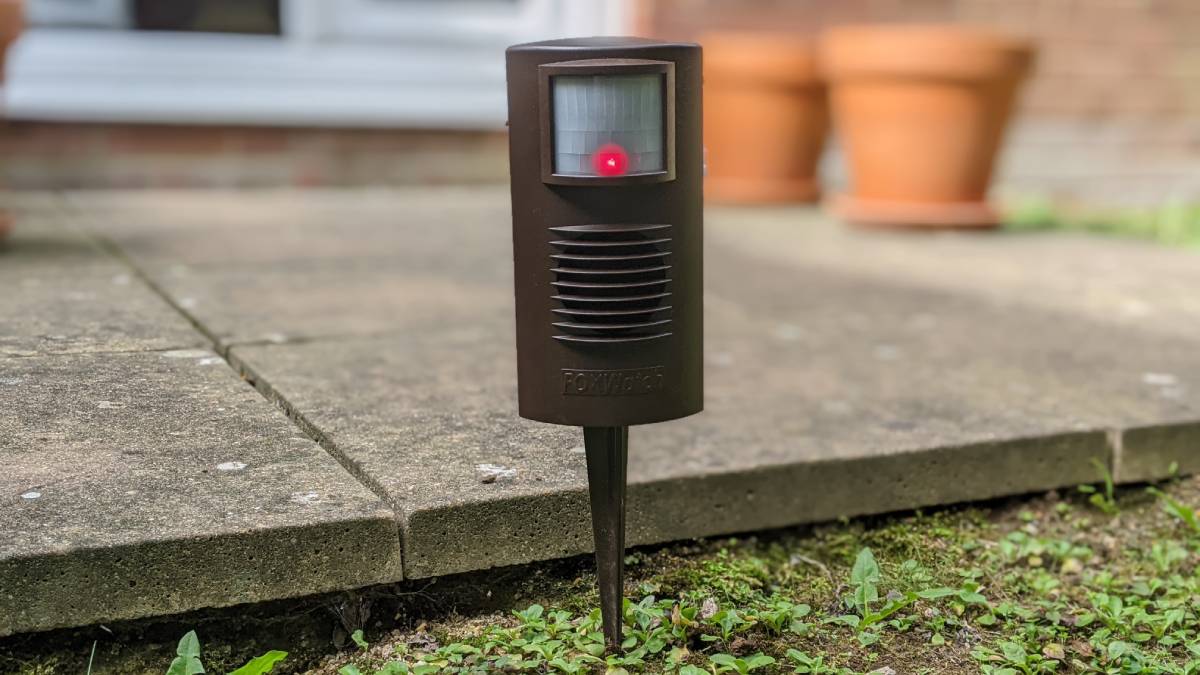
An ultrasonic device aimed at deterring foxes will usually be a small plastic unit that can be pushed into the ground using an accompanying mounting spike. Common locations are in lawns or flowerbeds facing out into the garden. Many devices can also be hung on a wall or fence.
Inside the unit, there will be two main components:
- Passive Infrared (PIR) Sensor – A motion and body heat sensor that is activated when the fox moves across the device’s detection zone.
- Speaker – The activation of the PIR sensor triggers the speaker, which emits the ultrasonic noises towards the fox. The noises will continue until the fox leaves the detection zone.
Provided the sounds are emitted at the most effective frequency (32 – 36 kHz), the loud bursts of ultrasonic noise will annoy and irritate the fox.
Over time, the fox will instinctively want to leave the area in order to avoid the unpleasant noise and any potential confrontation. (Just to reiterate, these noises are inaudible to humans).
Through repeated encounters with an ultrasonic fox deterrent, foxes are literally trained not to hang around in gardens, or other areas in need of protection. It becomes a behavioural habit as foxes start to associate the protected garden with danger and irritation and no longer want to spend time there.
Its important to note that ultrasonic fox deterrents aren’t designed to create an invisible barrier or prevent foxes from ever appearing; rather, it deters them from lingering long enough to cause damage. The goal is to make your garden an uncomfortable or uninteresting place for them to stay.
You can use a good quality ultrasonic fox deterrent to keep foxes away from lawns, flowerbeds, patios, driveways or anywhere else they’re causing a nuisance. It’s a process that is completely humane and automated, saving you from having to chase off trespassing foxes yourself.
Have ultrasonic repellers been scientifically studied?
While no major studies have focused exclusively on foxes, two respected scientific trials have tested the effects of ultrasonic deterrents on cats, animals that share very similar hearing ranges and behavioural patterns with urban foxes.
Importantly, these studies weren’t conducted in artificial lab settings. They tested ultrasonic devices in real gardens, under everyday conditions, just like yours.
The results clearly demonstrated that when used correctly and at the right frequencies, high-quality ultrasonic deterrents can be very effective at keeping unwanted animals out of gardens.
Both studies are outlined below and offer strong reassurance that the principle behind ultrasonic repellents, such as the British-made FOXWatch Ultrasonic Fox Deterrent, is sound and proven.
The RSPB study
Because cats are estimated to be responsible for the deaths of approximately 27 million birds every year in the UK, the Royal Society for the Protection of Birds (RSPB) co-funded a scientific study of the UK-made ‘CATWatch’ Ultrasonic Cat Deterrent to see if it improved the situation in gardens.
The study was conducted over a 2-year period, in over 70 gardens across the UK, with the results being published in the peer-reviewed journal, Applied Animal Behaviour Science.
The results of the study proved to be very positive, with the research concluding:
- The CATWatch reduced the probability of a cat intrusion into a garden by approximately 32%.
- The average duration of the intrusions was reduced by up to 38%.
- The magnitude of the deterrent effect appeared to increase with time.
- Cats were learning to avoid gardens with active CATWatch devices, rather than becoming habituated to them.
- The deterrent effect could be increased even further by positioning the CATWatch facing the point at which cats gain entry to the garden.
The results of this study has led to the RSPB adopting the CATWatch as their approved ultrasonic method of humanely deterring cats from gardens.
The British company that makes the device used in this study also makes the popular FOXWatch Ultrasonic Deterrent, which uses the same ultrasonic technology and detection methods, but emits sounds at a slightly higher frequency.
The Murdoch University study
The School of Veterinary and Life Sciences at Murdoch University, Western Australia, built on the research done by the RSPB’s CATWatch testing and conducted their own, even more sophisticated study of the effectiveness of ultrasonic devices on cats.
Their study, which was published in the peer-reviewed publication Global Ecology and Conservation, was conducted on 78 cats, across a wide range of gardens in Perth, Western Australia. It also used camera monitoring to gain greater insight into the effectiveness of the ultrasonic devices.
The results were even more positive, with the study concluding:
- The ultrasonic deterrents reduced the frequency of incursions into gardens by 46%.
- The duration of incursions was reduced by 78%.
- Ultrasonic deterrents offer a cost-effective, humane option to reduce incursions by unwanted cats.
- Ultrasonic deterrents may not prevent all incursions, but they will reduce the frequency and duration of their visits.
Due to the large cat population in Australia and the threat they pose to indigenous species, ultrasonic devices are a common sight in gardens in order to deal with the increasing problem of cat intrusions.
So what does this mean for foxes?
While foxes weren’t the direct subjects of these studies, they have comparable hearing ranges and behavioural responses to cats. Given that the technology is the same, and that the FOXWatch has been on the market for over 20 years, the results are a strong vote of confidence in the product’s overall effectiveness.
“The day after installing [the ultrasonic device], I put up a wildlife camera borrowed from friends. It showed foxes appearing from the strip of woodland and then either turning straight back or hesitating, circling and then retreating. The digging almost completely stopped.“
Roger, Sheffield
5 tips to use an ultrasonic fox deterrent effectively
Installing an ultrasonic fox deterrent in your garden is a very easy process, but with the additional tips below, you can ensure that the device is working to maximum effect in reducing the frequency and duration of the fox’s visits to your garden.
1. Find the fox’s entry point
As mentioned in the scientific studies, the entry point to a garden is really important. If you can find the place where the fox comes into your garden, you’re setting yourself up to be much more successful.
Installing the ultrasonic device overlooking the entry point means the fox will trigger the high-pitched noises as soon as it comes into your garden, and likely when it leaves again too.
If the fox’s first and last impressions of the garden are unpleasant, it will learn to associate your garden with the ultrasonic noises much more quickly, ultimately reducing its intrusions and causing less of a nuisance.
2. Install the device correctly
Most ultrasonic fox deterrents can either be pressed into the ground, via an accompanying spike, or hung on a fence or wall.
If using the spike, make sure the device is perpendicular (at 90°) to the ground. Don’t allow it to lean too far forward or backward, as this will limit the detection range of the motion sensor.
If fence or wall-mounting, keep the device low, no higher than 8 – 10 inches (20 – 25cm) off the ground. The motion sensors are usually angled slightly downwards so as to pick up movement on the ground in front of it (i.e. at fox height). Mounting the device at that low height will maximise the detection zone and avoid any blind spots underneath the unit.
3. Use mains power (if possible)
There are some cheap ultrasonic devices available that contain internal rechargeable or solar-powered batteries. These tend to degrade pretty quickly and will not hold enough charge to emit sufficiently loud noises to be effective against foxes.
You’ll get far better results if you use a device that enables you to connect up to the mains via an adapter. That will ensure a consistent 12 Volts is going into the unit, emitting loud ultrasonic blasts without the diminishing returns of rechargeable internal batteries.
If you don’t have a convenient plug socket then you can still get excellent results by inserting your own high-quality battery, such as Duracell Alkalines. Try and steer clear of anything else.
4. Don’t buy cheap
There are lots of very cheap ultrasonic devices on Amazon that can look very appealing at first glance. The problem with the really cheap ones is that you don’t always know what you’re actually getting.
Many will claim to repel all sorts of animals without specifying what frequency the units operate at, even though different animals respond to different frequencies. The optimum frequency for foxes is between 30 – 36kHz, so that’s the figure you need to look for.
Also keep in mind that your ultrasonic fox deterrent will need to sit outside for months on end and be able to withstand the wet British climate. Cheap devices will naturally use lower-quality components, so their longevity and ability to help resolve your fox problem over the long term is likely to be limited.
Finally, be wary of suspicious 5-star Amazon reviews on cheap ultrasonic products as they’re not necessarily genuine. A common example is a customer purporting to be from the UK but praising the device for getting rid of their terrible racoon/skunk/coyote problem in their ‘yard’. As we don’t have those animals in the UK, the authenticity of the review should be questioned. Proceed with caution.
5. Be patient (IMPORTANT!)
The scientific research makes it very clear that ultrasonic animal deterrents become more effective as time goes on. The more a fox encounters the high-pitched noises, the less time it will spend in your garden. The less time it spends in your garden, the less nuisance it will cause.
However, this also means that you need to set your expectations accordingly and accept that the fox won’t disappear instantaneously. Ultrasonic deterrents are not a magic wand, but the longer you leave the unit in place, the more effective it will become.
If you’ve ever read mixed reviews on ultrasonic animal deterrents, a lack of patience and giving up before the device has had a chance to have an impact is the most likely reason why.
What’s the best ultrasonic fox deterrent in the UK?
Hopefully, this article has answered a lot of your questions regarding the effectiveness of an ultrasonic fox deterrent and helped provide you with enough information to decide if your garden would benefit from installing one.
The FOXWatch Ultrasonic Fox Deterrent
If you’re looking for a low-maintenance way of humanely reducing unwanted cat intrusions in your garden, then consider purchasing a FOXWatch Ultrasonic Deterrent.
Just like the RSPB-approved CATWatch, the FOXWatch is also manufactured by the same company in Stevenage, UK, using high-quality components designed to operate outside and withstand the wet British climate. This means you’ll be able to rely on the FOXWatch to provide a continuous, deterrent effect in your garden for the long-term.
Not only does it have the peace of mind of a 2-year manufacturer’s warranty, but you’ll also have the satisfaction of knowing you’re solving your problem with the help of innovative British engineering.
The video below shows you just how easy it is to get the FOXWatch set up in your garden in under 5 minutes.
“The fact that I can put the FoxWatch out into the garden and forget about it is great. It’s kept my back garden clear of foxes for nearly a year now.“
Mr Longman, Croydon
The FOXWatch Ultrasonic Fox Deterrent is available in our store priced £69.95 and includes a 12 Volt mains adapter, full operating instructions, 90-day moneyback guarantee, 2-year manufacturer’s warranty and free UK delivery.
FOXWatch FAQs
Is the FOXWatch safe for use with dogs?
Yes, the FOXWatch is absolutely fine to use with dogs.
A large proportion of people who buy the FOXWatch are actually dog owners worried about the risk of germs from fox poo, their dogs getting agitated when seeing a fox in the garden or the fear of attack, especially on smaller dogs.
After the FoxWatch has been installed and there is a reduction of fox visits to the garden, dog owners tend to feel much more relaxed about letting their dogs into the garden without worrying about germs, agitation or attack.
EXTRA TIP – Dog pee is a great supplementary fox deterrent, so feel free to encourage your dog to pee in areas of your garden where you’ve seen the fox, especially at the point they get in. This introduces a ‘rival scent’ to your garden and, if done on a regular basis, works really well in combination with the noise of the FOXWatch.
Is the FOXWatch safe for use with cats?
Yes, the FOXWatch is absolutely fine for use with cats.
In fact, the scent of foxes in the garden may be causing your cat quite a lot of stress, so the sooner you take steps to keep the fox away, the sooner your cat can relax again.
It’s possible the fox could be making your cat fearful of leaving your house. Some common symptoms include a reluctance to use the cat flap, going to the toilet in the house or going out into the garden nervously and keeping low to the ground, constantly sniffing the floor. It’s also not unheard of for foxes to enter via the cat flap, raid the food bowl and terrify the resident cat in the process!
Installing a FOXWatch will help to reduce the visits of the fox to your garden, in turn reducing the stress levels in your cat and giving it the confidence to use the cat flap and enjoy the garden again.
Will the FOXWatch scare birds from my garden?
No, the FOXWatch doesn’t have any effect on birds and won’t discourage them from coming into your garden.
Foxes have been described as a ‘catlike canine’ for many reasons, including their ability to stalk and catch birds in a similar way to cats.
A reduction in fox visits to your garden may well see an increase in birds visiting as well as spending longer each visit due to decreased fear of a predator (subject to local cats of course!).
EXTRA TIP – If you enjoy feeding the birds, try and avoid throwing kitchen scraps out onto your lawn or patio. The smell of the food will attract foxes and possibly mice and rats as well. Try and stick to birdseed installed in hanging bird feeders or high up out of reach of foxes (and cats). This will be safer for the birds and gives less of a reason for foxes to be tempted into your garden.
Will the FOXWatch affect children or babies?
No. The sound it emits is above the range of human hearing, so it is completely safe for children and babies.
Is the FOXWatch safe for use with rabbits/chickens/guinea pigs etc...?
Yes, the FOXWatch is completely fine to use with these small animals and should be considered a must-have deterrent to help protect them.
These small animals are unfortunately very attractive to foxes, so you need to do whatever you can to keep them safe. A FoxWatch can provide an important part of your arsenal to protect your small pets, as would electric fencing or mesh, a quality scented deterrent and using strong and secure cages or pens.
When you have such tempting ‘fox prey’ in your garden, the greater variety of deterrent methods you use, the better.
Is installation complicated?
No, not at all. Simply screw the plastic spike into the bottom of the device, position the unit in your garden, connect it to the mains (or insert a battery), and switch it on. No tools or expertise required.
If you’re planning to mount the device on a wall or fence, you can hang it on a screw or a nail. Make sure the FOXWatch is mounted no higher than 8 – 10 inches off the ground (i.e. fox height) so that the device can pick up movement on the ground in front of it. Mounting it too high will create a blind spot underneath it.
We recommend that you either position the device:
- Facing the point at which the fox comes into your garden, as this means it will hear the high-pitched noises as soon as it enters, or,
- Facing the area where the fox spends the most time or causes the most damage.
How do foxes react to the FOXWatch?
When you first install the FOXWatch, foxes are likely to show a great deal of interest in the device. A new object making irritating high-pitched sounds has suddenly appeared in their territory, so they are immediately going to be concerned. Their initial reaction will be to try and work out what this thing is and if they can overpower it.
Foxes staring, sniffing, attacking, pooing or spraying urine on the FOXWatch are very common reactions the first few times they encounter it, so don’t be surprised or worried if you initially see this happening in your garden. These are positive signs and show that the foxes are very concerned about the FOXWatch and are trying to intimidate and establish dominance over it.
It’s important that you leave the FOXWatch in place for at least 30 days (ideally longer) to allow it the time to teach the foxes that this irritation is permanent. It’s through their repeated encounters with the FOXWatch that they learn to associate your garden with the annoying ultrasonic noises. This causes their visits to your garden to get fewer and farther between, with each visit shortening in duration as they find somewhere else to go.
How long does the FOXWatch take to work?
We advise you to use the FOXWatch for at least 30 days to allow for the full deterrent effect to be achieved.
Training a fox to associate your garden with the irritating high-pitched noises is a gradual process, resulting in the fox spending less and less time in your garden as time goes on.
As you’ve already discovered, foxes are very persistent animals so it’s important that you remain patient and allow enough time for this process to take place.
We like to use the phrase ‘a marathon, not a sprint’ in regards to successful fox deterrence. Start with this mindset and you’ll be much happier with your progress!
How many FOXWatch devices do I need?
There’s no right or wrong answer regarding how many FOXWatch devices you should install. This is entirely dependent on your individual situation, garden set up and how severe your fox problem is.
Some questions to ask yourself to help you decide are:
- Do you have fox problems in one area or in multiple areas (e.g. your front/back garden/driveway/down the side etc..)?
- Do you have one fox or multiple foxes visiting?
- Do the foxes enter and exit your garden in one place or in different places?
- Is your garden a regular shape or irregularly shaped (e.g with corners, slopes or tiers/levels)?
Some people only need one FOXWatch to reduce their fox problems, while others require numerous devices to protect all affected areas. You know your garden and the nature of your fox problem best, so ask yourself the questions above and think about what you might need.
If in doubt, start with one FOXWatch and then add more devices later if you feel you need them. We have many people who come back for more once they see the device having a positive impact.
It’s always better to take some sort of decisive action rather than over-thinking it and doing nothing.
What distance does the FOXWatch cover?
The FOXWatch can detect up to 12m (40ft) and covers an unobstructed area of up to 125sqm (1350 sq ft).
Is the FOXWatch weatherproof?
Yes, the FOXWatch is made in Britain and specifically designed to cope with the notoriously wet and windy British climate, as well as the wild temperature fluctuations that it will naturally experience when sat out in your garden
The internal components are made from the highest quality materials and are securely sealed in a waterproof resin to provide the longest possible operating life.
Many cheaper alternatives to the FOXWatch are not made with the wet British weather in mind and are mass-produced (often in China) with much lower quality internal components – naturally shortening the life expectancy of those units.
Of course, in the event of freak weather conditions, such as monsoon-style rain or heavy snowfall, bring the FOXWatch in for a few hours to dry out before setting it to work again. Like anything, the more you look after it, the longer it will last and continue to deter foxes.
Additionally, every FOXWatch comes with a comprehensive 2-year manufacturer’s warranty covering any applicable repairs or replacements required to the unit during that period.
Does the FOXWatch work at night?
Yes. The infrared sensor activates 24/7, so it protects your garden during the day and at night, when foxes are most active. The FOXWatch should be left switched on at all times, so no matter when foxes are active in your garden, they will face a deterrent.
Why do you recommend using the mains adapter rather than a battery?
Because the mains adapter provides 12 Volts into the FOXWatch, rather than 9 Volts from a battery – that’s 33% more power. More power means a louder, more effective noise to deter the fox. Plus you don’t have to worry about replacing a flat battery.
The mains adapter comes with a 10m (32ft) cable. We also stock a 10m extension cable which allows you to install your FOXWatch up to 20m (64ft) away from a plug socket.
Although we recommend using the adapter, we understand it’s not possible for everyone and using a 9V battery in the FOXWatch still provides a very effective fox deterrent. Just make sure it’s a Duracell Alkaline 9 Volt Battery so that you get maximum power and reliability from your FOXWatch.
Many cheaper alternatives to the FOXWatch do not contain a mains adapter and often use rechargeable or solar powered batteries to power the units. These kind of batteries degrade fairly quickly and are unlikely to contain enough charge to provide the powerful noise required to keep foxes out of your garden over the long term.
How long does a battery last?
A 9 Volt Duracell battery will normally last 2 – 3 months. The lights on the FOXWatch will flash to warn you when the battery is running low.
We recommend you use a Duracell alkaline battery rather than cheap brands or rechargeables, as these can quickly degrade and won’t provide enough power to the unit, which in turn means the noise emitted from the unit is less powerful.
If you allow a battery to go completely flat and don’t replace it, the deterrent effect of the FOXWatch will stop.
Will the FOXWatch protect a large garden/school field/bowling green/tennis court/sports pitch?
The FOXWatch has a massive unobstructed protection area of 125sqm (1350sqft) which is far greater than most other competitors’ coverage.
This makes the FOXWatch suitable for a huge range of environments including small gardens, large gardens, open gardens, playing fields, farms, schools, bowling greens, grass tennis courts and sports pitches.
Many people who have particularly large spaces requiring protection from foxes often purchase multiple FOXWatch units, either placing them in rows at with certain distances between one another or placing them back to back for greater circular protection.
Can the FOXWatch be moved around the garden?
To start with, we recommend that you either:
- install the FOXWatch facing the point at which the foxes enter your garden or,
- install the FOXWatch facing the area the foxes spend the most time or cause the most damage.
Leave the device in place for a little while and see what happens. Foxes rarely change their behaviour overnight, so give yourself enough time to assess the impact of the FOXWatch, then adjust if necessary.
If you later discover the foxes come in somewhere else or their behaviour changes and they move to a different part of your garden to avoid the FOXWatch, then by all means move the device to a different location.
You might find this is sufficient, or you might need to consider adding an additional device to your garden to cover all areas where the foxes are active.
What if my neighbour also has a FOXWatch? Will they interfere?
No. Multiple devices can be used in the same area without any problems. In fact, neighbours often find using them together provides even stronger protection.
If you’ve got neighbours with a FOXWatch then count yourself lucky. One of the main reasons foxes come into gardens is because a neighbour feeds them and attracts them to the area.
Can the FOXWatch be used alongside other repellents?
Yes, absolutely. And if you have a serious fox problem in your garden then the more types of repellents you use the better results you’ll get.
The FOXWatch targets a fox’s sense of hearing, Scoot and citronella sprays target the sense of smell, prickle strips target the sense of touch, flashing lights target the sense of sight. The more of the fox’s senses you can target, the more likely it will reduce the time it spends in your garden.
For other types of deterrents, please read our article The Top 10 Fox Repellents UK
What’s the big deal about the FOXWatch being made in the UK?
Whilst it’s absolutely important to promote British manufacture, the answer is actually practical rather than political.
The FOXWatch is the only ultrasonic fox deterrent fully designed and manufactured in the UK and each unit is hand-built and quality-control tested before it leaves the plant in Stevenage.
It’s undergone rigorous and extensive trials with British urban foxes, in British gardens and is specifically designed to withstand the British weather.
The cheaper alternatives are generally manufactured in China, which isn’t a problem in itself, but mostly means they have not been tested on the UK’s urban foxes, and are built with lower quality components not capable of lasting as long in our damp and wet climate.
The manufacturer of the FOXWatch provides a comprehensive 2 year warranty and even an additional repair service once the warranty has expired. They have a long history of manufacturing high quality animal deterrents and are very approachable and welcoming of questions or requests for assistance.
What is the warranty and the guarantee?
All of our FOXWatch units come with a 2 year manufacturer’s warranty which covers repair or replacement in the unlikely event something goes wrong with a unit. We also provide a 90 day money back guarantee. Any returns should be made using the original packaging and please contact us first.
Not in the UK?
If you’re in the USA, Canada or Germany, then you’ll find the articles below helpful, which include the best ultrasonic fox devices available in your region.
Made in the UK

Proudly designed and manufactured in the UK, the FOXWatch is the only ultrasonic fox deterrent created specifically for British gardens and the country’s red fox population.
Unlike many imported devices, its PIR infrared technology has been specifically designed for British conditions, making sure it performs exactly as needed against the behaviour of the UK’s foxes. From heavy rain to freezing winters, the FOXWatch is engineered to withstand the unpredictable British climate, giving you reliable protection all year round.
The Stevenage-based manufacturer has an excellent reputation for quality and innovation, with close ties to respected organisations such as the RSPB and the Mammal Research Unit at the University of Bristol, as well as recognition from leading home and garden publications.
Every FOXWatch is hand-assembled in the UK, and each unit is individually tested before leaving the factory. Backed by a two-year manufacturer’s warranty, this careful craftsmanship gives you the confidence that your device will work exactly as intended.
This level of reliability is precisely what’s needed to successfully deter foxes and change their behaviour, helping you take back control of your garden.